Explore
Wander without destination.
Showing byrecent
8 dives · 1 playlist


Riohacha
Riohacha is a city in the Riohacha Municipality in the northern Caribbean Region of Colombia by the mouth of the Ranchería River and the Caribbean Sea. It is the capital city of the La Guajira Department. It has a sandy beach waterfront.

Francis Drake
Sir Francis Drake was an English explorer and privateer best known for making the second circumnavigation of the world in a single expedition between 1577 and 1580. He is also known for participating in the early English slaving voyages of his cousin, John Hawkins, and John Lovell. Having started as a simple seaman, in 1588 he was part of the fight against the Spanish Armada as a vice admiral.

Thousand Days' War
The Thousand Days' War was a civil war fought in Colombia from 17 October 1899 to 21 November 1902, at first between the Liberal Party and the government led by the National Party, and later – after the Conservative Party had ousted the National Party – between the liberals and the conservative government. Caused by the longstanding ideological tug-of-war of federalism versus centralism between the liberals, conservatives, and nationalists of Colombia following the implementation of the Constitution of 1886 and the political process known as the Regeneración, tensions ran high after the presidential election of 1898, and on 17 October 1899, official insurrection against the national government was announced by members of the Liberal Party in the Department of Santander. Hostilities did not begin until 11 November, when liberal factions attempted to take over the city of Bucaramanga, leading to active warfare. It would end three years later with the signing of the Treaty of Neerlandia and the Treaty of Wisconsin. The war resulted in a Conservative victory, and ensured the continued dominance of the Conservative Party in Colombian politics for another 28 years. Colombia's political structure as a unitary state has not been challenged since.

Banana Massacre
The Banana Massacre was a massacre of workers of the United Fruit Company that occurred between December 5 and 6, 1928, in the town of Ciénaga near Santa Marta, Colombia. A strike began on November 12, 1928, when the workers ceased to work until the company would reach an agreement with them to grant them dignified working conditions. After several weeks with no agreement, in which the United Fruit Company refused to negotiate with the workers, the government of Miguel Abadía Méndez assigned Carlos Cortés Vargas as military chief in the Magdalena department and sent 700 men from the Colombian Army to quell the strikers, resulting in the massacre of 47–2000 people.

Open Veins of Latin America
Open Veins of Latin America: Five Centuries of the Pillage of a Continent is a 1971 book written by Uruguayan journalist, writer, and poet Eduardo Galeano that analyzes the impacts of European settlement, imperialism, and slavery on Latin America.


Royal Tombs of the Joseon Dynasty
The Royal Tombs of the Joseon Dynasty (Korean: 조선왕릉) is a UNESCO World Heritage Site registered in 2009 that includes 40 tombs of members of the House of Yi, which ruled Korea between 1392 and 1910. The tombs are scattered over 18 locations across the Korean Peninsula. They were built to honor the ancestors and their achievements, and assert royal authority. Two other Joseon tombs, located in Kaesong, North Korea, were proposed but not submitted.

Yeongneung
Yeongneung is the joint tomb of King Sejong the Great of the Joseon dynasty and his wife, Queen Soheon. It is the first joint burial of a king and queen in the Joseon royal tombs. Located in Yeoju, Gyeonggi Province, South Korea, it forms part of the Yeongnyeongneung cluster of royal tombs, which is designated as Historic Site No. 195 and a UNESCO World Heritage Site as part of the Royal Tombs of the Joseon Dynasty.


Ming tombs
The Ming tombs are a collection of mausoleums built by the emperors of the Ming dynasty of China. The tomb of the first Ming ruler, the Hongwu Emperor, is located near his capital Nanjing. However, the majority of the Ming tombs are located in a cluster near Beijing and collectively known as the Thirteen Tombs of the Ming dynasty. They are located within the suburban Changping District of Beijing Municipality, 42 kilometers (26 mi) north-northwest of Beijing's city center. The site, on the southern slope of Tianshou Mountain, was chosen based on the principles of feng shui by the third Ming emperor, the Yongle Emperor. After the construction of the Imperial Palace in 1420, the Yongle Emperor selected his burial site and created his own mausoleum. Most of the subsequent emperors placed their tombs in the same valley.

Forbidden City
The Forbidden City is the imperial palace complex in the center of the Imperial City in Beijing, China. It was the residence of 24 Ming and Qing dynasty Emperors, and the center of political power in China for over 500 years from 1420 to 1924. The palace is now administered by the Palace Museum and has been a UNESCO World Heritage Site since 1987. The Forbidden City is one of the most famous palaces in all of Chinese history, and is the largest preserved royal palace complex still standing in the world.

Imperial Tombs of the Ming and Qing Dynasties
Imperial Tombs of the Ming and Qing Dynasties is the designation under which the UNESCO has included several tombs and burial complexes in the list of World Heritage Sites. These tombs date from the Ming and Qing dynasties of China.

Western Qing tombs
The Western Qing tombs are located some 140 km (87 mi) southwest of Beijing in Yi County, Hebei Province. They constitute a necropolis that incorporates four royal mausoleums where seventy-eight royal members are buried. These include four emperors of the Qing dynasty and their empresses, imperial concubines, princes and princesses, as well as other royal servants.

Summer Palace
The Summer Palace or Yihe Garden was built by the Chinese Empress Cixi as a pavilion for quiet retreat. It is a vast ensemble of lakes, gardens and palaces in Beijing. An imperial garden during the Qing dynasty, it includes Longevity Hill, Kunming Lake, and Seventeen Hole Bridge. It covers an expanse of 2.9 square kilometres (1.1 sq mi), three-quarters of which is water.

Grand Canal (China)
The Grand Canal is a system of interconnected canals linking various major rivers and lakes in North and East China, serving as an important waterborne transport infrastructure between the north and the south during Medieval and premodern China. It is the longest artificial waterway in the world and a World Heritage Site.


Torii
A torii is a traditional Japanese gate most commonly found at the entrance of or within a Shinto shrine, where it symbolically marks the transition from the mundane to the sacred, and a spot where kami are welcomed and thought to travel through.

Hongsalmun
In Korean architecture, a hongsalmun is a gate for entering a sacred place. Also called hongjeonmun or hongmun, it is usually erected to indicate Korean Confucian sites, such as shrines, tombs, and academies such as hyanggyo and seowon. It is also installed in front of palaces and villages that produced loyal subjects and filial sons. It was first made in the Silla dynasty.


Ferghana horse
Ferghana horses were one of China's earliest major imports, originating from the Fergana Valley in Central Asia. These horses, as depicted in Tang dynasty tomb figures in earthenware, may "resemble the animals on the golden medal of Eucratides, King of Bactria ."
Nisean horse
The Nisean horse, or Nisaean horse, is an extinct horse breed once native to the plains near modern-day Hamadan, Iran.


Republic of Venice
The Republic of Venice, officially the Most Serene Republic of Venice and traditionally known as La Serenissima, was a maritime republic with its capital in Venice, on the northeastern coast of Italy. Founded, according to tradition, in 697 by Paolo Lucio Anafesto, over the course of its 1,100 years of history it established itself as one of the major European commercial and naval powers. Initially extended in the Dogado area, during its history it annexed a large part of Northeast Italy, Istria, Dalmatia, the coasts of present-day Montenegro and Albania as well as numerous islands in the Adriatic and eastern Ionian seas. At the height of its expansion, between the 13th and 16th centuries, it also governed Crete, Cyprus, the Peloponnese, a number of Greek islands, as well as several cities and ports in the eastern Mediterranean.

Metropolitan City of Venice
The Metropolitan City of Venice is a metropolitan city in the region of Veneto in northern Italy, one of the ten metropolitan cities in Italy. Its capital is the city of Venice. It replaced the province of Venice in 2015 and includes the city of Venice and 44 municipalities (comuni). It was first created by the reform of local authorities and then established by Law 56/2014. It has a population of 834,077 in an area of 2,472.91 square kilometres (954.80 sq mi).

League of Cambrai
The League of Cambrai was a military coalition against the Republic of Venice formed on 10 December 1508, by the main European powers, the Holy Roman Empire and the Kingdom of France, in order to expand their hegemony over the Italian Peninsula. The League was formalized by two treaties, both signed on 10 December 1508 in Cambrai, first being a dynastic treaty between Habsburg and Valois rulers, and the second being a wider treaty of military alliance against the Venetians. It gave its name to the War of the League of Cambrai (1508–1511). In March 1509, the League was joined by the Crown of Aragon, and also by Pope Julius II, who issued an interdict against the Venetians on 27 April. Already in 1510 the League was left by the Pope, who sided with the Venetians. In 1511 the League continued to dissolve, being abandoned by the king of Aragon, and it finally collapsed in 1512 when the emperor concluded truce with the Venetians, thus leaving the French to continue the war alone.

Empire of Nicaea
The Empire of Nicaea, also known as the Nicene Empire, was the largest of the three Greek rump states founded by the aristocracy of the Byzantine Empire that fled when Constantinople was occupied by Western European and Venetian armed forces during the Fourth Crusade, a military event known as the Sack of Constantinople. Like the other Byzantine rump states that formed due to the 1204 fracturing of the empire, such as the Empire of Trebizond and the Despotate of Epirus, it was a continuation of the eastern half of the Roman Empire that survived well into the Middle Ages. A fourth state, known in historiography as the Latin Empire, was established by an army of Crusaders and the Republic of Venice after the capture of Constantinople and the surrounding environs.

Phrygian cap
The Phrygian cap, also known as Thracian cap and liberty cap, is a soft conical cap with the apex bent over, associated in antiquity with several peoples in Eastern Europe, Anatolia, and Asia. The Phrygian cap was worn by Thracians, Dacians, Persians, Medes, Scythians, Trojans, and Phrygians after whom it is named. The oldest known depiction of the Phrygian cap is from Persepolis in Iran.

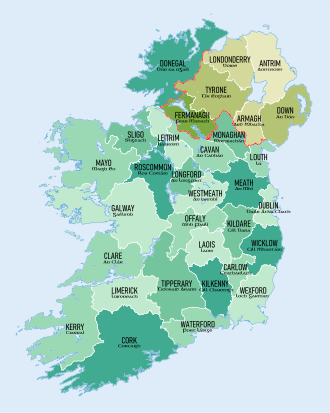
Counties of Ireland
The counties of Ireland are historic administrative divisions of the island. They began as Norman structures, and as the powers exercised by the Cambro-Norman barons and the Old English nobility waned over time, new offices of political control were established at a county level. The number of counties varied depending on the time period, however thirty-two is the traditionally accepted and used number.

Auld Alliance
The Auld Alliance was an alliance between the kingdoms of Scotland and France against England made in 1295. The Scots word auld, meaning old, has become a term for the long-lasting association between the two countries. The alliance was never formally revoked, although it is considered by some to have ended with the signing of the Treaty of Edinburgh in 1560.


Catherine the Great
Catherine II, commonly known as Catherine the Great, was the Empress of Russia from 1762 to 1796. She came to power after a coup d'état against her husband, Peter III. Her long reign helped Russia thrive under a golden age during the Enlightenment. This renaissance led to the founding of many new cities, universities, and theatres, along with large-scale immigration from the rest of Europe and the recognition of Russia as one of the great powers of Europe.

Novorossiya
Novorossiya is a historical name, used during the era of the Russian Empire for an administrative area that later became the southern mainland of Ukraine: the region immediately north of the Black Sea and Crimea. The name Novorossiya, which means "New Russia", entered official usage in 1764, after the Russian Empire conquered the Crimean Khanate, and annexed its territories, when Novorossiya Governorate was founded. Official usage of the name ceased after 1917, when the entire area was annexed by the Ukrainian People's Republic, precursor of the Ukrainian SSR.